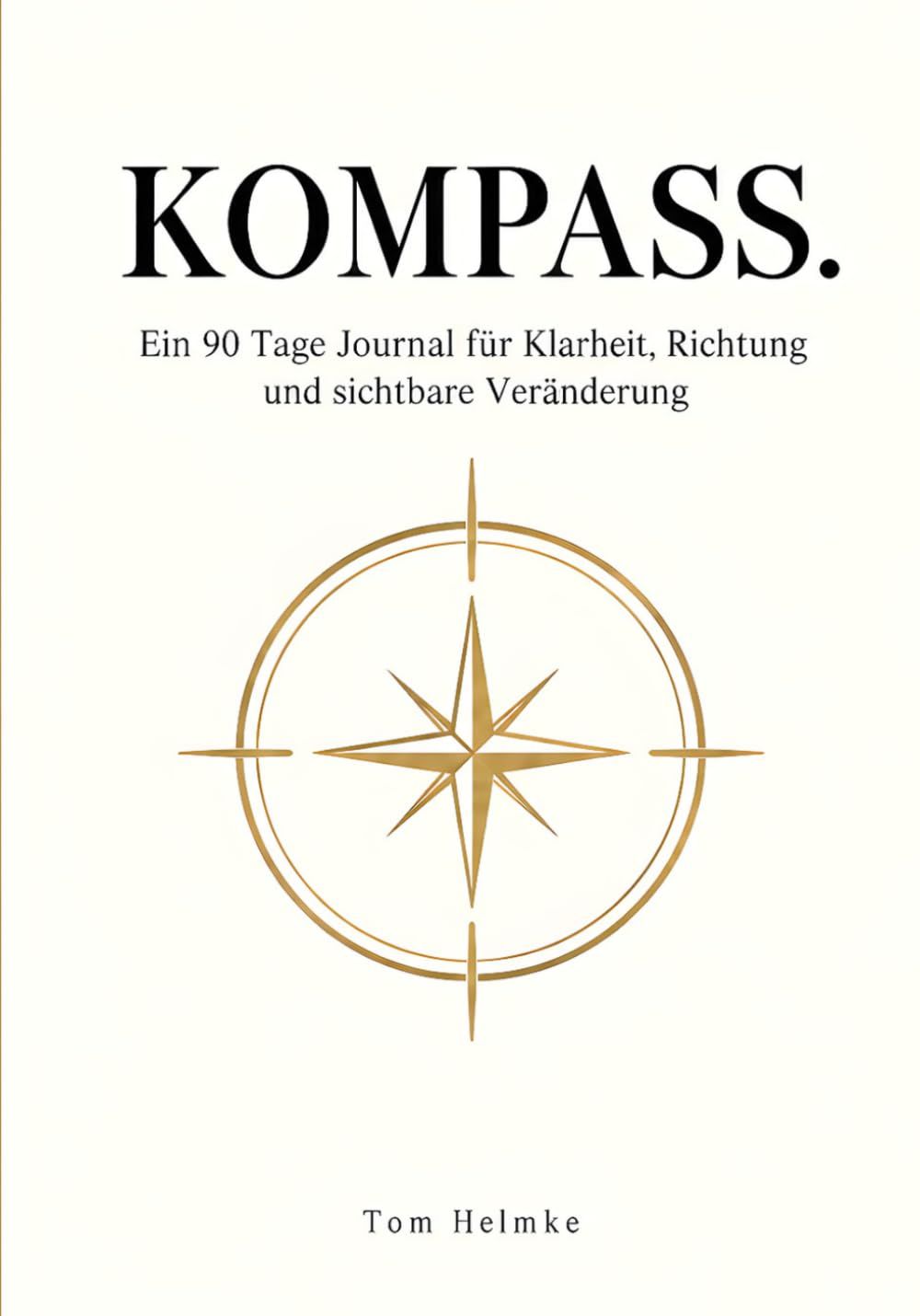
Journal
KOMPASS.
Ein 90-Tage-Journal für Klarheit, Richtung und sichtbare Veränderung
You think a lot about what should change. KOMPASS. helps you find the direction that really suits you and put it into practice for 90 days. Written in German.
Book language: German This book is written in German. The description on this page is in English.
- Pages
- 240
- Edition
- Paperback
- Published
Available on Amazon
View on Amazon (Amazon.com, United States), external linkStore: Amazon.com · United States
Choose another Amazon store (13)
- Australia Amazon.com.au , external link
- Belgium Amazon.com.be , external link
- Canada Amazon.ca , external link
- France Amazon.fr , external link
- Germany Amazon.de , external link
- Ireland Amazon.ie , external link
- Italy Amazon.it , external link
- Japan Amazon.co.jp , external link
- Netherlands Amazon.nl , external link
- Poland Amazon.pl , external link
- Spain Amazon.es , external link
- Sweden Amazon.se , external link
- United Kingdom Amazon.co.uk , external link
There is no separate Amazon paperback store for Austria or Switzerland. Amazon.de is the nearest option; Amazon decides whether and on what terms it delivers.
Books are sold exclusively through Amazon. This website does not sell books. Prices, shipping and availability are set by Amazon and may differ by country.
Related title
- COMPASS. A related book in English
About the book
KOMPASS. (German for “compass”) is a journal for people who do not simply want to become more productive, but to find out which direction really suits them. The 90 days begin with an honest look at your life: time, work, money, health, relationships, environment and the decisions you keep making.
This includes asking which goals are truly your own and which expectations you have taken on from others. From there you build a personal compass with clear values, a concrete picture of the future, three direction statements and visible outcomes for the next 90 days.
Daily questions connect that picture with reality. Weekly checks and detailed reflections after 30, 60 and 90 days show what has actually changed, and open fields leave room for thoughts, symbols, sketches and images. The journal promises neither a perfect life nor change through positive thinking alone. It is written in German.
A look inside


Who the book is for
- German-speaking readers at a turning point who want to redefine their direction
- Anyone who wants to check which goals are truly their own
- Readers who want to turn values and priorities into concrete steps
- Readers who prefer a clearly defined period to an open-ended project
How the journal is structured
- Taking stock
Time, work, money, health, relationships, environment, decisions, and your own and adopted expectations.
- Your personal compass
Values, a concrete picture of the future, three direction statements and visible outcomes for 90 days.
- Daily pages
Questions that connect intention and reality every day.
- Weekly checks
Regular reviews to spot patterns and adjust decisions.
- Reflections after 30, 60 and 90 days
Detailed reviews of what has really changed.
Examples from the book
- Was soll heute ein Stück realer werden?
- Was ist die erste konkrete Handlung?
- Was hast du tatsächlich getan?
- Welche Entscheidung passt zu deiner Richtung?
- Wo weichst du noch aus?
Using it day to day
- Before starting, an honest look at your own life
- Then set your personal compass: values, a picture of the future, three direction statements and visible outcomes
- Every day, short questions that connect intention and reality
- A weekly check every week and a detailed reflection after 30, 60 and 90 days
What the book contains
- A 90-day journal with an initial stocktake, written in German
- Values, priorities, a picture of the future, three direction statements and visible 90-day outcomes
- Daily questions, weekly checks and reflections after 30, 60 and 90 days
- Open fields for thoughts, symbols, sketches and images
- 240 pages in a generous 17.78 × 25.4 cm format
What research says about the methods
The studies below examine general methods that also appear in this journal. They do not show that this particular book works, and they are no substitute for professional advice or treatment.
-
Clear goals instead of vague intentions
A review of decades of goal-setting research concludes that specific, challenging goals led to better performance in many studies than simply intending to “do your best”. Feedback on progress strengthened this relationship.
-
Planning concretely: when, where, how
Plans of the form “If situation X arises, then I will do Y” showed a medium to large effect on goal attainment in a meta-analysis of 94 tests. A plan does not replace motivation; it makes the step from intention to action easier.
-
Recording progress
A meta-analysis of 138 studies found that interventions prompting people to monitor their progress helped them reach their goals on average. The effect was larger when progress was physically recorded or reported to others.
-
What writing can and cannot do
Studies on writing about personal experiences show small average effects that vary widely between people and situations. A review of journaling for mental illness found a small to moderate benefit, with very mixed evidence. A journal can be a useful tool, but it is not therapy.
Book details
- Author
- Tom Silas Helmke
- Book language
- German
- Category
- Journal
Paperback
- Pages
- 240
- Trim size
- 17.78 × 25.4 cm (7 × 10 in)
- Publication date
- ASIN
- B0HJMKRWM3